To: Alexander Smith, Managing Editor: Medicine & Health Science Journals Taylor & Francis Group Copy: Siegfried Kasper, MD, Chief Editor, the World Journal of Biological Psychiatry 10 July 2015
Regarding the request for retraction of the article “Efficacy and safety of prolonged-release OROS methylphenidate in adults with attention deficit/hyperactivity disorder” published in the World Journal of Biological Psychiatry
After three months I have now received your answer that you intend to do nothing to correct the false and misleading data in article. I must say this came as a complete surprise. Your earlier interested and swift attention to the matter changed to a short note saying you will do nothing about the matter.
You are not sharing any of the arguments from your investigation to not retract or correct the article, and on top of that I get to know that the matter is confidential.
Please allow me to object to the unscientific handling of this important matter. First if all: Openness and transparency are core features of science. But instead of letting me know the details of what was found in your investigation you simply state: “… there are no grounds to consider publishing a correction.” This of course ends the scientific discussion; we don’t get any information about what data formed the basis for this conclusion.
I further object to the stamp “Confidential” in your letter. Instead of keeping this outside the public domain it should be made known and widely discussed.
In order to advance the scientific handling of the matter I want to ask some detailed and pertinent questions and hope you will tell me what your investigation has said about them:
1. In the article [1] the following conclusion about efficacy in the study is presented: “OROS MPH [Concerta] provided overall benefits in the treatment of adults with ADHD”. The independent evaluation [2] of this study from the drug regulatory agency (MHRA), on the point of “Efficacy” concluded: “This is clearly a failed study”.
Question: In light of the analysis and conclusion in the independent evaluation of the study, do you consider the conclusion about efficacy in the article by Janssen and the authors to be correct?
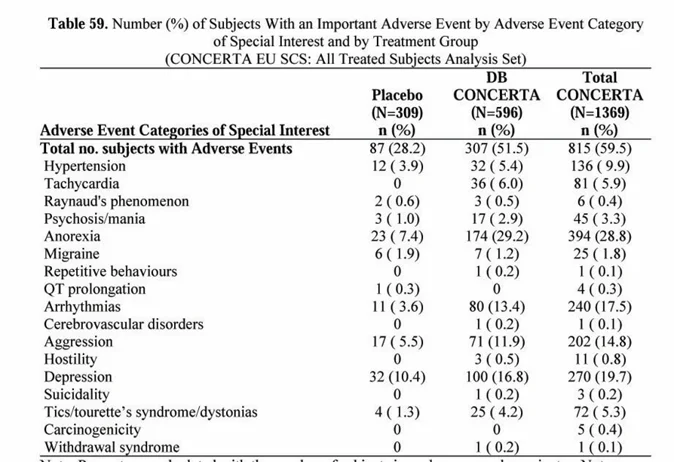
2. In the article [1] the following conclusion about safety is presented: “OROS MPH was well tolerated in the study.” The independent evaluation of this study from the drug regulatory agency (MHRA) found that 19 percent of the subjects (34 of 182) receiving Concerta discontinued the study (compared to 2 percent in the placebo group) due to adverse effects. For the three Concerta studies on adults the assessment concluded: “The main new safety concern from the study data is around the frequency of psychiatric adverse events and that this is often de novo [new]. Of note is the incidence of anxiety but also rates of depression and aggressive and hostile behavior are raised.” [3] As can be seen in the
assessment, the serious safety concerns stemmed mainly from the study presented in the World Journal of Biological Psychiatry.
Question: In light of the analysis and conclusion in the independent evaluation of the study, do you consider the conclusion about safety in the article by Janssen and the authors to be correct?
3. In the article [1] we don’t find anything about aggression or aggression related events. In the independent evaluation we could find the conclusion about the three Concerta studies: “A causal relationship with Concerta was established for aggression, tics and depression.” As seen from the evaluation there was a clear correlation between the duration of the studies and the adverse events. The serious safety concerns also in this area stemmed mainly from study presented in the World Journal of Biological Psychiatry.
Question: In light of the analysis and conclusion in the independent evaluation of the study, do you consider that the complete omission of aggression related events from Concerta in the article is in line with the rules for “Good Conduct in Research”, or do you as I do, consider this as a misrepresentation of the research process by dishonest exclusion of data?
Thank you for your willingness to advance the scientific handling of this matter by answering my questions.
Kind Regards,
Janne Larsson Reporter/Researcher Sweden
[1] Casas, Rösler, Kooij, Ginsberg, Ramos-Quiroga, Heger, Berwaerts, Dejonckheere, van der Vorst, Schäuble. “Efficacy and safety of prolonged-release OROS methylphenidate in adults with attention deficit/hyperactivity disorder: A 13-week, randomized, double-blind, placebo-controlled, fixed-dose study.” The World Journal of Biological Psychiatry, Early Online November 2011, in print May 2013. http://informahealthcare.com/doi/abs/10.3109/15622975.2011.600333 [2] MHRA, Final Variation Assessment Report, Concerta Day 90, April 26, 2011, see page 5 https://jannel.se/docs/fvar-concerta-day90-260411 [3] MHRA, Preliminary Variation Assessment Report, Concerta, July 2010, see p. 66 https://jannel.se/docs/pvar-concerta140710
From: Smith, Alexander Sent: Thursday, July 9, 2015 5:10 PM To: jan.olov.larsson@telia.com Subject: CONFIDENTIAL World Journal of Biological Psychiatry
Dear Mr Larsson,
We have now completed our investigation into the concerns you expressed with respect to the article “Efficacy and safety of prolonged-release OROS methylphenidate in adults with attention
deficit/hyperactivity disorder” published in World Journal of Biological Psychiatry, and find there are no grounds to consider publishing a correction.
We now consider the matter closed.
Yours sincerely
Alexander Smith
Alexander Smith – Managing Editor: Medicine & Health Science Journals Taylor & Francis Group
From: Jan Larsson Sent: Thursday, June 4, 2015 8:58 PM To: Smith, Alexander Cc: Farr, Francesca Subject: Re: Request for Retraction of Journal Article
Dear Alex,
Thank you for letting me know.
Kind Regards,
Janne Larsson
From: Smith, Alexander Sent: Thursday, June 4, 2015 9:48 AM To: jan.olov.larsson@telia.com Cc: Farr, Francesca Subject: RE: Request for Retraction of Journal Article
Dear Janne,
Just to provide you with an update on this as I realise there has been a slight delay. We are just getting this looked at by an independent reviewer and hope to have a response for you within the next few weeks.
Best wishes,
Alex
From: Smith, Alexander Sent: 21 May 2015 14:02 To: 'jan.olov.larsson@telia.com' Cc: Farr, Francesca Subject: RE: Request for Retraction of Journal Article
Dear Janne,
Thanks for your email which has been passed onto us by Professor Kasper, the Editor-in-chief of the Journal.
Taylor & Francis is a member of the Committee on Publication Ethics (COPE) and consequently, we will be investigating this as per their guidelines. We will be back in touch with you shortly when a final decision has been made about this paper.
All best wishes,
Alex
Alexander Smith – Managing Editor: Medicine & Health Science Journals Taylor & Francis Group 4 Park Square, Milton Park, Abingdon, Oxon, OX14 4RN, UK
Von: Jan Larsson <jan.olov.larsson@telia.com> Datum: Mittwoch, 20. Mai 2015 22:28 An: Andrea King <wfsbp@meduniwien.ac.at> Betreff: Request for Retraction of Journal Article
Dear Mr. Kasper,
I now get back to you about the serious matter taken up in my letter two months ago
What I can see there has been no action taken as regards the article, but I assume the Editorial Board has completed its investigation.
I think it is very important that we can trust that scientic journals – after all mistakes made the last decades – give us a full, honest, scientific presentation of the actual research results, with correct conclusions. As you understood from my letter the article mentioned did not live up to these requirements.
I hope to hear from you soon that appropriate actions in line with my request will be taken.
Thank you again for taking this matter seriously!
Kind Regards,
Janne Larsson Reporter/Researcher Sweden
From: Jan Larsson Sent: Tuesday, March 24, 2015 6:06 PM To: The World Journal of Biological Psychiatry Subject: Re: Request for Retraction of Journal Article
Dear Mr. Kasper,
Thank you for taking this matter seriously, and for taking action. I assume that the authors (or Janssen) do not really agree to the conclusions by the drug regulatory agency. However that clear conclusion was made after a thorough reanalysis of the study data, based on additional information submitted by the company.
Kind Regards,
Janne Larsson Reporter/Researcher Sweden
From: The World Journal of Biological Psychiatry Sent: Tuesday, March 24, 2015 12:56 PM To: Jan Larsson Subject: Re: Request for Retraction of Journal Article
Dear Mr. Larsson,
Thank you very much for raising these aspects. We have already asked the authors to comment on the issues as soon as possible.
Sincerely yours,
Siegfried Kasper, MD Chief Editor, The World Journal of Biological Psychiatry
Professor and Chair Department of Psychiatry and Psychotherapy Medical University Vienna, MUV AKH, Währinger Gürtel 18-20 A-1090 Vienna AUSTRIA
Phone: ++43 1 40400 35680 Fax: ++43 1 40400 30990
Email: wfsbp@meduniwien.ac.at http://www.wfsbp.org/ http://www.meduniwien.ac.at/biologicalpsychiatry/
Von: Jan Larsson <jan.olov.larsson@telia.com> Datum: Samstag, 21. März 2015 12:34 An: Andrea King <wfsbp@meduniwien.ac.at>
Cc: Rainer Rupprecht <Rainer.Rupprecht@medbo.de> Betreff: Request for Retraction of Journal Article
To: Editorial Board, Chief Editor, of the World Journal of Biological Psychiatry http://www.wfsbp.org/educational-activities/the-world-journal-of-biological-psychiatry/wjbp-editorial-board-structure.html
See text below in PDF https://jannel.se/docs/requestretraction
This is a request for the World Journal of Biological Psychiatry to withdraw the article “Efficacy and safety of prolonged-release OROS methylphenidate in adults with attention deficit/hyperactivity disorder: A 13-week, randomized, double-blind, placebo-controlled, fixed-dose study”, published early online November 2011, in print May 2013 [1].
In the article the following conclusion of the study is presented: “OROS MPH provided overall benefits in the treatment of adults with ADHD”. As regards safety, the conclusion was: “OROS MPH was well tolerated in the study.”
The study behind the article (Study 3013) was chosen by the manufacturer of Concerta, Janssen, as the longest of three double-blind studies submitted to European drug regulators for the approval of Concerta for adults in Europe. The UK regulator, Medicines and Healthcare products Regulatory Agency (MHRA), acted as reference member state, leading the assessment of the studies.
In the assessment of Study 3013 the MHRA came to a diametrically opposed conclusion about both efficacy and safety compared to what is published in article. The MHRA reached the following conclusion in its Final Assessment Report from April 2011: “This is clearly a failed study” [2].
As for safety MHRA's study emphasized that 19 percent of the subjects (34 of 182 ) receiving Concerta discontinued the study (compared to 2 percent in the placebo group) due to adverse effects.
From the three studies of Concerta the assessment concluded: “The main new safety concern from the study data is around the frequency of psychiatric adverse events and that this is often de novo [new]. Of note is the incidence of anxiety but also rates of depression and aggressive and hostile behavior are raised.” [3] We could also read: “A causal relationship with Concerta was established for aggression, tics and depression.” The serious safety concerns stemmed mainly from Study 3013.
We can in the article in the World Journal of Biological Psychiatry see that four of the ten listed authors of the study were employees of Janssen (Johnson & Johnson), one was a former employee and the other five authors had been consulting for the pharmaceutical company or had worked in the company's Advisory Board. The clear negative assessment of Study 3013 was known to Janssen and its employees 8 months ahead of the publication in the Journal. Yet the conclusions in the article were not changed.
I hope the Editorial Board of the Journal welcome the above data and I request that the article, with its false and misleading presentation and conclusions, is retracted.
Kind Regards,
Janne Larsson Reporter/Researcher Sweden
[1] Casas, Rösler, Kooij, Ginsberg, Ramos-Quiroga, Heger, Berwaerts, Dejonckheere, van der Vorst, Schäuble. “Efficacy and safety of prolonged-release OROS methylphenidate in adults with attention deficit/hyperactivity disorder: A 13-week, randomized, double-blind, placebo-controlled, fixed-dose study.” The World Journal of Biological Psychiatry, Early Online November 2011, in print May 2013. http://informahealthcare.com/doi/abs/10.3109/15622975.2011.600333 [2] MHRA, Final Variation Assessment Report, Concerta Day 90, April 26, 2011, see page 5 https://jannel.se/docs/fvar-concerta-day90-260411 [3] MHRA, Preliminary Variation Assessment Report, Concerta, July 2010, see p. 66 https://jannel.se/docs/pvar-concerta140710